Settings: Heating curve, domestic hot water, auxiliary heater, …
The Bosch CS 5800/6800i and Buderus WLW176/186i offer a variety of settings. This page shows the most important menu items relating to the heating curve, room temperature, domestic hot water, and other parameters relevant to efficiency and comfort.
Many settings can be configured in the service menu. To access the service menu, press and hold the service button (3 lines at the top left of the display) for at least 5 seconds. Some settings can also be configured directly on the control unit’s start screen. Most settings on the start screen can also be found in the app.
The most important settings, but by no means all of them, are briefly explained below.
Room temperature
Use Start screen → Desired temperature to set the desired temperature that you want to achieve in the heated rooms.
Without a connected room thermometer from the heat pump accessories, the set room temperature does not necessarily correspond to the actual room temperature.
This is not particularly significant technically.
If you nevertheless want to align the two values, you can set a correction value under System settings → Heating/Cooling → Heating circuit 1 → Heating → Room temperature offset.
For the most constant possible low output, a constant room temperature is preferable.
This can be achieved by selecting Manual under Start screen → Desired temperature.
However, if you prefer to use a night setback of the room temperature, you can do so by selecting Auto.
And if you do not want to rely on automatic summer/winter changeover, you can select Off during the summer months.
This switches off the heating.
Domestic hot water production remains possible.
Heating curve
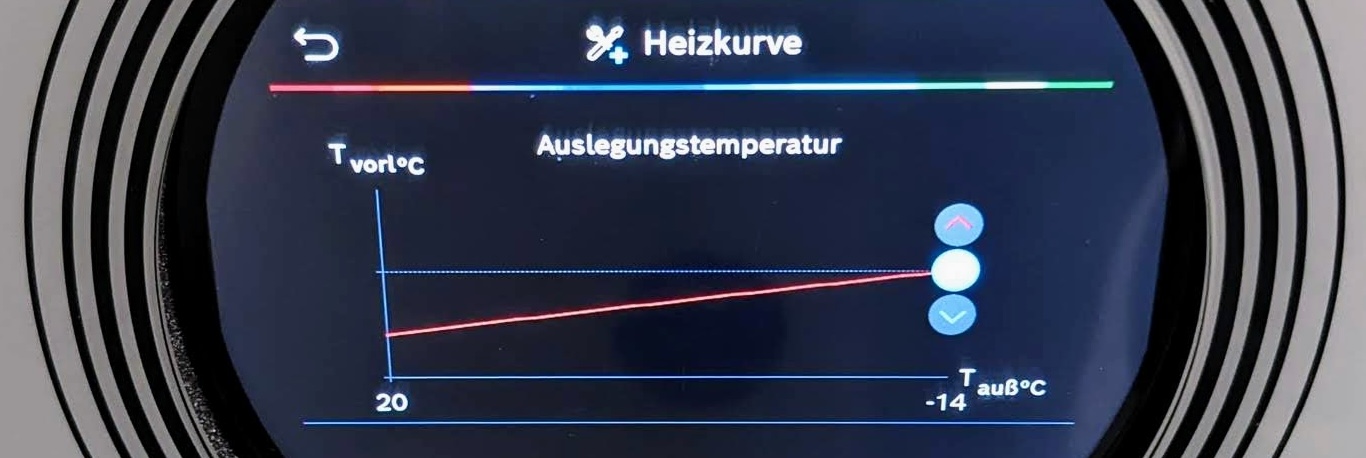
When it gets colder outside, the heating system must provide more output to keep the rooms at the desired temperature. To do this, it increases the flow temperature of the heating water. The extent of this increase is determined by the heating curve.
Control mode
The control mode defines the basis on which the target flow temperature is determined and can be set under
System settings → Heating/Cooling → Heating circuit 1 → Heating → Control mode:
Outside temperature controlled: the heating curve is defined exclusively by the flow temperature at the minimum outside temperature (far right at -14 °C in the image above)Outside temperature with base point: additionally allows the flow temperature to be set at an outside temperature of 20 °C, the so-called base point (far left in the image above)Individual room controlled: the actual room temperature is taken into account if a room thermostat from the heat pump accessories is connected
Outside temperature damping
For all settings relating to the outside temperature, it should be noted that it does not affect the inside of the building at the same time.
When it gets colder outside, it takes some time for the cold to affect the rooms.
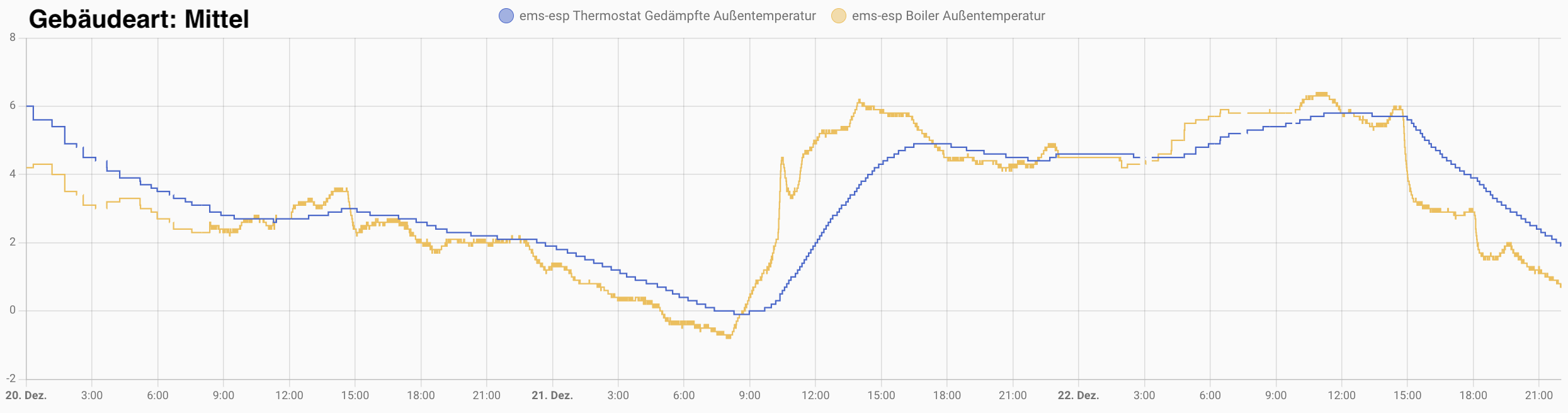
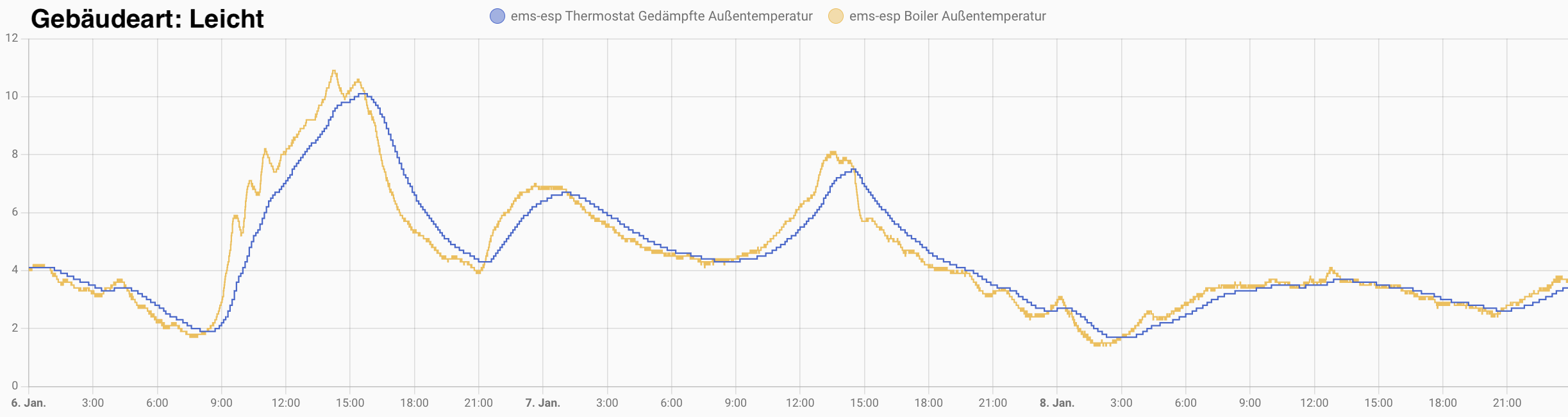
This inertia is set using the building damping under System settings → Heating/Cooling → System settings → Building type damping and results in the so-called damped outside temperature.
The “heavier” the building, the more slowly changes in outside temperature take effect, as shown in the following diagrams for medium and light building types:
Heating limit
Naturally, it does not make sense to operate the heating system at summer outside temperatures.
Use System settings → Heating/Cooling → Heating circuit 1 → Summer/Winter changeover → Heating operation up to or Start screen → Desired temperature → More... → Heating off from to set the temperature limit at which the heating period should begin, e.g. 15°C.
It should be noted that the changeover does not take place immediately when the temperature limit is reached, in order to prevent constant switching on and off at outside temperatures around the limit value. A delay for the transition from winter to summer and from summer to winter can be set under the following menu items:
System settings→Heating/Cooling→Heating circuit 1→Summer/Winter changeover→Summer operation delay: if the limit temperature has been exceeded for the set duration, the heating is switched offSystem settings→Heating/Cooling→Heating circuit 1→Summer/Winter changeover→Heating operation delay: if the limit temperature has been undershot for the set duration, the heating is switched on
To also account for an abrupt drop in temperature, a temperature difference in Kelvin or °C can be set under
System settings → Heating/Cooling → Heating circuit 1 → Summer/Winter changeover → Temperature difference immediate start, at which the heat pump starts immediately.
Design outside temperature
System settings → Heating/Cooling → System settings → Minimum outside temperature
Here you set the design outside temperature (DOT), i.e. the lowest temperature that has been maintained 10 times within 20 years for a period of at least two consecutive days. The design outside temperature can be looked up at the German Heat Pump Association (BWP).
Flow temperature (DOT)
System settings → Heating/Cooling → Heating circuit 1 → Heating → Heating curve
Pressing the end point selects it. You can then use the arrow keys to set the required flow temperature at the DOT.
In addition to these values, you can also define the base and comfort points if the simple heating curve is not sufficient.
Heating curve simulator
Here you can check your heating curve values:
Domestic hot water production
Domestic hot water production can be carried out using any of these 3 modes:
- Comfort
- Eco
- Eco+
There is also the Extra domestic hot water mode, which attempts to heat the domestic hot water to the stop temperature on request for 1..48 hours.
The following values can be individually set for each mode under System settings → Domestic hot water:
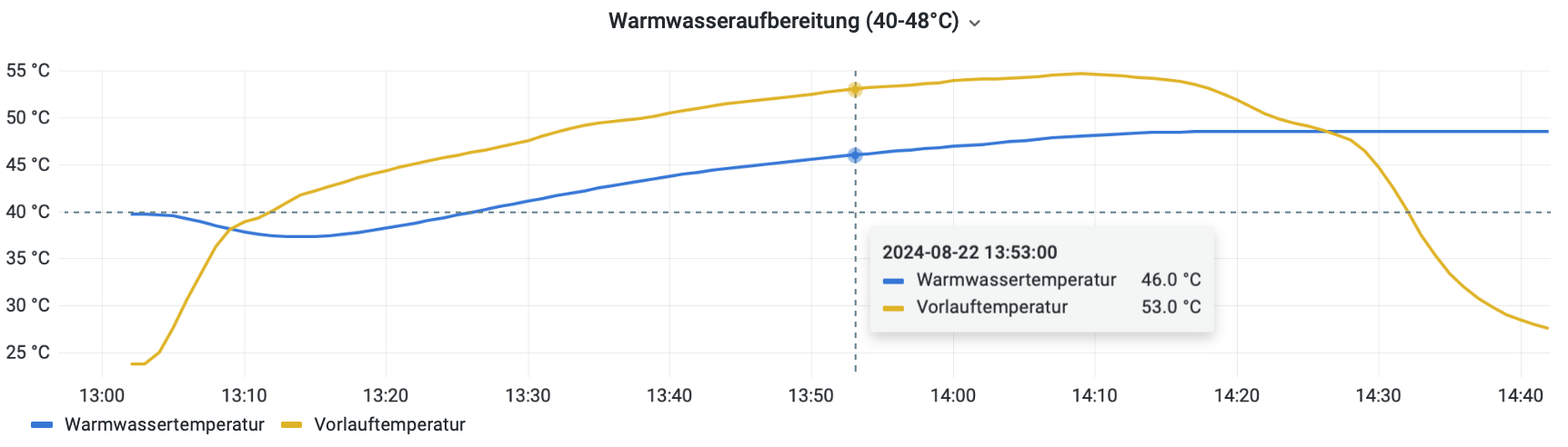
Start temperature: domestic hot water production starts when this temperature limit is undershotStop temperature: domestic hot water production ends when this temperature limit is reachedCharging delta: the flow temperature is increased by this value for domestic hot water production—the higher the charging delta, the faster the heating
The following diagram shows the flow temperature and domestic hot water temperature for Start temperature=40°C, Stop temperature=48°C and Charging delta=7K:
Modes
| Mode | Min. start temperature | Max. stop temperature | Charging delta |
|---|---|---|---|
| Comfort | 40 °C | 65 °C | 6..18 K |
| Eco | 35 °C | 60 °C | 6..18 K |
| Eco+ | 30 °C | 55 °C | 6..15 K |
| Extra-DHW | 50..70 °C |
Mode selection
The mode for domestic hot water production can be selected either in the app or on the control panel under Start screen → Domestic hot water:
Off: no domestic hot water productionManual: a mode is selected manuallyAuto: the corresponding mode is selected automatically based on the current time of day. The program that should be active at which time of day must be configured for this.
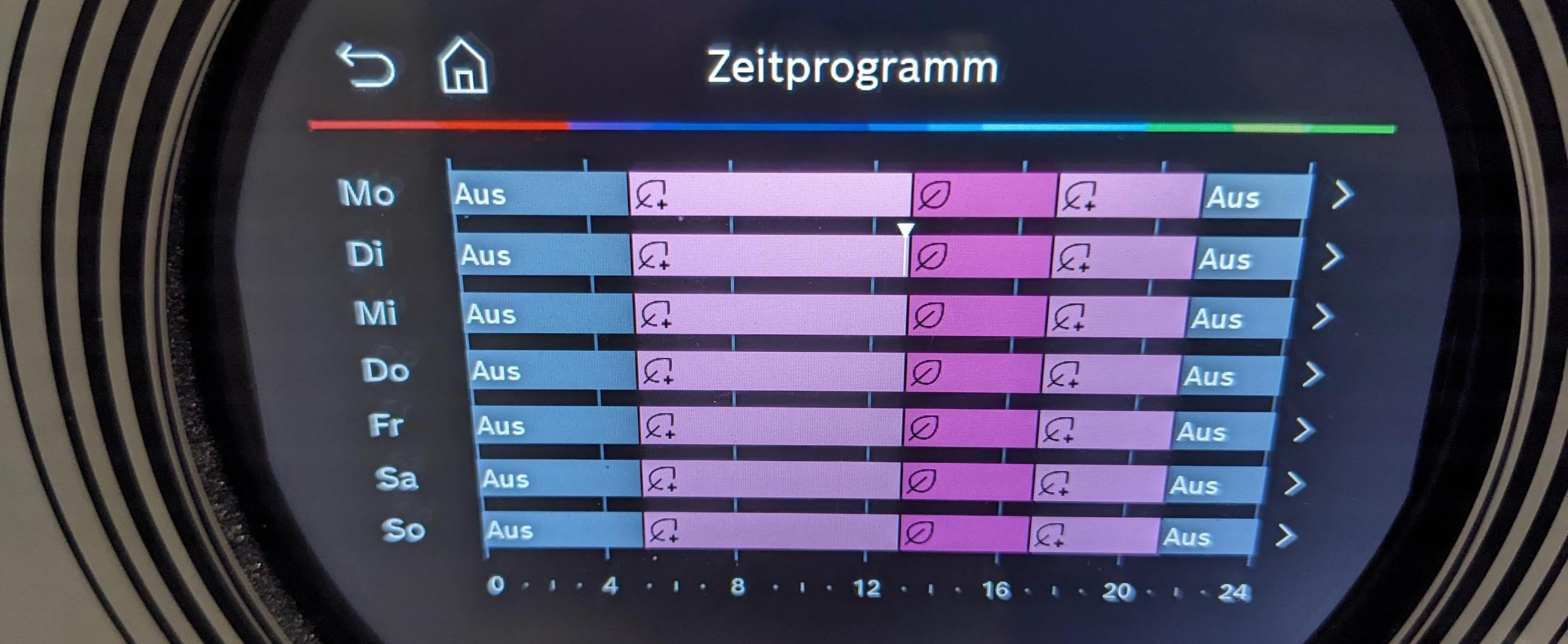
The time programs for Auto mode can either be configured in the app under Domestic hot water → Calendar bottom right or on the control panel’s start screen (not in the service menu) under Domestic hot water → More...> → Time program → Edit.
In the display above, domestic hot water production is off from 21:00-5:00, domestic hot water is heated using Eco+ mode from 5:00-13:00 and 17:00-21:00, and domestic hot water is produced using Eco mode from 13:00-17:00.
Electric auxiliary heater
Heat pumps should be dimensioned so that they can cover the building’s heat demand down to approximately -5 °C (Bosch).
Below this temperature range, the heat pump is supported by an electric auxiliary heater.
The settings for the electric auxiliary heater can be configured under System settings → Auxiliary heater.
Auxiliary heater lock
If System settings → Auxiliary heater → Auxiliary heater lock is activated, the electric auxiliary heater is not used for regular heating operation or domestic hot water production, even at low temperatures.
It can still be used for frost protection and the defrost cycle despite the auxiliary heater lock.
Power limitation
The following settings can be configured under System settings → Auxiliary heater → Electric auxiliary heater:
Limitation with compressor
Value range: 0kW, 3kW, 6kW, 9kW
This setting defines the maximum output of the electric auxiliary heater to support the heat pump during operation.
Limitation without compressor
Value range: 0kW, 3kW, 6kW, 9kW
This can be used to set the maximum output of the electric auxiliary heater when the compressor is not running, for example in emergency operation.
Limitation in DHW operation
Value range: 0kW, 3kW, 6kW, 9kW
This setting defines the maximum output of the electric auxiliary heater that may be used for domestic hot water production.
Bivalent point parallel operation
The temperature limit mentioned above at which the auxiliary heater should support the heat pump, the so-called bivalent point, is specified in this menu item, e.g. -7°C.
Heating delay
However, the auxiliary heater is not switched on based on the bivalent point set above, but according to the failure to reach the target flow temperature, configured as a temperature-difference-time product, e.g. 600 K*min. In this case, 600 K*min means that the auxiliary heater is switched on in the following example situations:
- The target flow temperature is undershot by 10 K (°C) for 60 minutes
- The target flow temperature is undershot by 2.5 K (°C) for 4 hours
- The target flow temperature is undershot by 1 K (°C) for 10 hours